
For Physicians, NPs, PAs, Chiropractors & Healthcare Teams
Massage therapy FAQs for medical professionals
Created as a practical guide to massage therapy for medical professionals, this page brings together when focused care may fit, how we select techniques, what helps in a referral and what patients can expect from our office. It is designed for physicians, nurse practitioners, physician assistants, chiropractors, physical therapists, dentists and other healthcare professionals.
Rated 4.9 out of 5 on Google
Care led by Marla Kaplan, LMT, Certified Lymphatic Therapist.
For referring providers
Fax or send orders to our office, or call to discuss a patient.
Phone: 631-462-4263 · Fax: 631-386-8404
Our Treatment Philosophy
Focused care begins with the reason the patient is here
The difference is not whether the massage feels therapeutic. It is the purpose, the plan and how the work responds to the patient’s presentation over time.
Therapeutic or relaxation-focused massage
May address general tension, stress, soreness and restoration. The session may be broader or full-body and shaped around comfort and relaxation goals.
Medical or condition-focused massage
Begins with a current complaint, functional concern or medically relevant goal. The work is specific and changes according to history, precautions, findings and response.
Responsive care, not a fixed routine
Treatment may be adjusted around areas of guarding, tenderness, tension or reduced tissue mobility. Patient feedback and functional response help guide technique, pressure and pacing.
The goal is meaningful functional improvement
Our aim is to support changes the patient can notice in comfort, movement or daily activity. Some people report improvement that continues between sessions; the degree and duration of response vary.
A Responsive Clinical Process
We treat the person in front of us—not the diagnosis on autopilot
A diagnosis or referral gives us important context. The session itself remains responsive to the patient’s history, current function, tissue presentation, comfort and response.
Listen
Clarify the concern, relevant history, precautions and activity limitations.
Assess
Observe movement and palpate for guarding, tenderness, tension and restriction.
Treat
Select and adjust hands-on techniques according to findings and goals.
Recheck
Repeat a relevant movement or functional task when appropriate.
Plan
Use the response to guide pacing, follow-up and the next reasonable step.
Technique Selection
The technique follows the clinical purpose
A medical massage session is rarely one named technique from beginning to end. Therapists may combine approaches, change pressure or positioning, and narrow or broaden the focus as the patient responds.
Focused soft-tissue work
Direct hands-on work for muscular tension, tenderness, guarding and reduced tissue mobility.
Neuromuscular and trigger-point work
Specific, tolerable pressure around sensitive or overactive tissue when it fits the presentation.
Myofascial techniques
Gentle or sustained input when fascial restriction appears to contribute to discomfort or limited movement.
Scar and post-surgical support
Careful work around guarding and tissue restriction when healing stage and medical guidance allow.
Dedicated specialty pathways
Some referrals call for a therapist with specific advanced training rather than a general medical massage appointment.
Function Matters
Progress should show up in the patient’s life
Pain scores can help, but function and duration of improvement often tell a more useful story.
- Turning the head more comfortably while driving
- Reaching overhead with less restriction
- Sleeping longer before discomfort returns
- Sitting or standing longer with fewer symptoms
- Walking or using stairs with greater ease
- Completing work or daily tasks more comfortably
Prescription & Referral Toolkit
When a prescription is needed, we make it simple
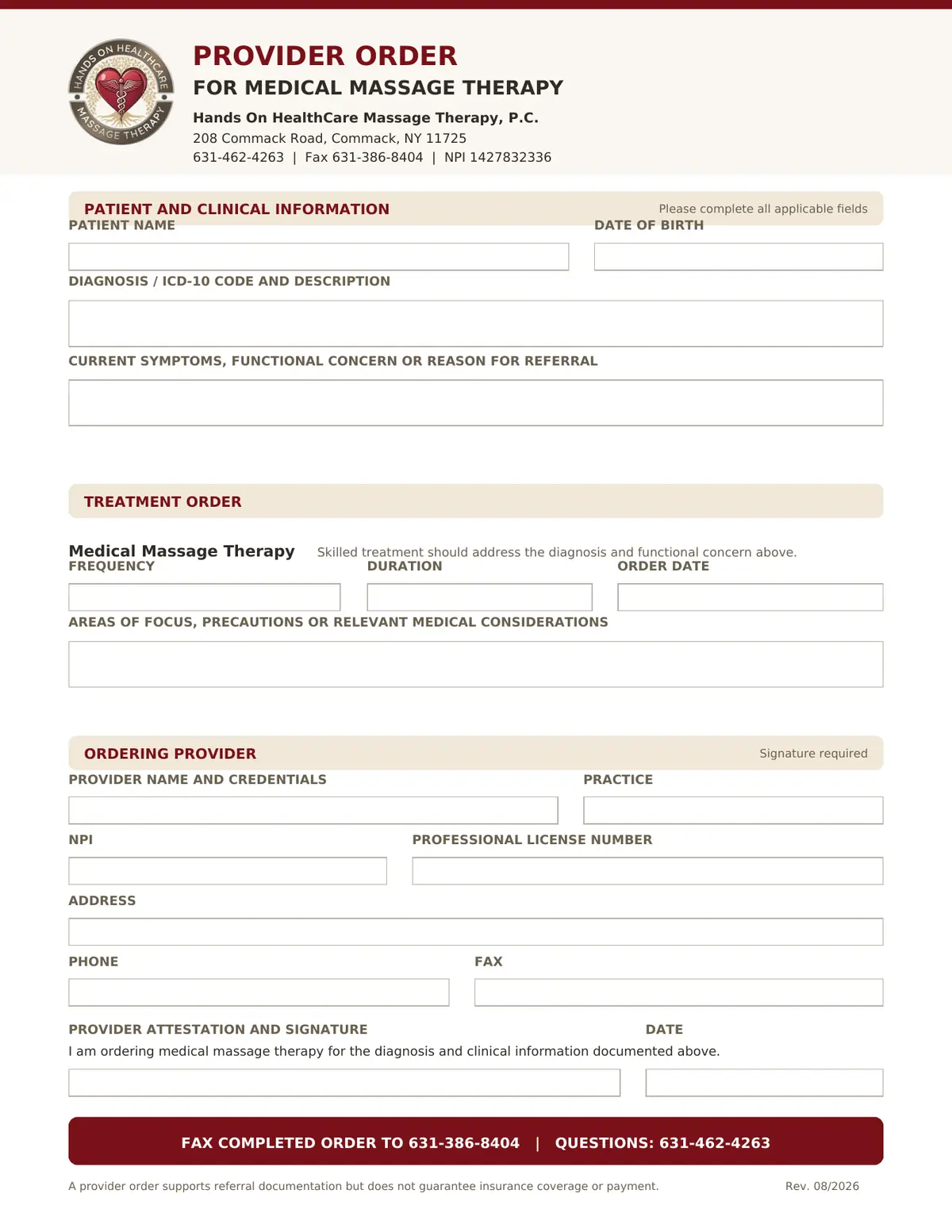
You may use our form, your prescription pad, an EMR referral or office letterhead. The goal is not more paperwork—it is enough clear information to connect the order to what the patient is experiencing now.
- Why now: the current complaint, diagnosis or functional concern.
- What you recommend: frequency, duration, focus areas and relevant precautions.
- Who is ordering: your identifying information, signature and date.
NYSHIP note: a prescription is required and should include the diagnosis or reason for care plus the prescribed frequency and duration. The prescription must remain valid. Please provide an updated prescription before it expires or its authorized treatment period or visits are exhausted.
Providers may fax a completed order to 631-386-8404. Please do not send sensitive patient information through ordinary email.
Massage Therapy Research
Research worth sharing
Massage therapy has been studied across pain, function, recovery and supportive oncology care. The evidence is not equally strong for every condition, but there is meaningful work for providers who want to look beyond promotional claims.
A 2024 review examined 129 systematic reviews of massage for painful adult conditions. No conclusion reached high certainty; the moderate-certainty conclusions that were identified favored massage for pain. Useful evidence deserves useful context.
Eight Common Questions
Medical professional FAQs
For patient-specific referral or documentation questions, call the office at 631-462-4263.
Does every patient need a prescription for medical massage?
No. Private-pay patients may receive medical massage without a prescription. NYSHIP requires one, while No-Fault and other plans may have different requirements. Our office checks the patient’s pathway before asking your team for paperwork.
What should a provider order include?
Include the patient’s name and date of birth; current diagnosis, ICD-10 code and description; symptoms or functional reason for referral; ordered frequency and duration; relevant focus areas or precautions; and the provider’s printed name, credentials, NPI, license number, contact information, signature, and date.
Your own prescription pad, EMR referral, or letterhead is acceptable if it contains the needed information.
What makes medical massage different from therapeutic massage?
Therapeutic massage may focus on general tension, soreness, stress and restoration. Medical or condition-focused massage begins with a current complaint, functional concern or medically relevant goal. The work is more specific and is adjusted according to history, precautions, findings and response. The approaches can overlap.
What does focused, responsive treatment mean at Hands On?
Medical massage may address areas of guarding, tension, tenderness or reduced soft-tissue mobility. The therapist uses specific hands-on techniques, patient feedback and repeated reassessment to guide the session. The goal is to support more comfortable movement and function; response and duration vary.
How do you choose the right therapist for my patient?
Our office reviews the reason for referral and matches the patient with a licensed massage therapist whose training and experience fit the care requested. Not every therapist provides every specialty service, and the treatment plan is adapted to the patient rather than handed to a fixed routine.
How do you judge whether treatment is helping?
We look beyond temporary relief on the table. Progress may be reflected in comfort, movement, tolerance, function and how long improvement is maintained between sessions. The treatment plan is adjusted according to the patient’s response.
Can massage complement physical therapy or other medical care?
Yes, when it is appropriate for the patient. Massage therapy can address muscles, fascia, guarding and soft-tissue restrictions as one part of a broader plan. It does not replace diagnosis, rehabilitation or treatment that belongs with another licensed profession.
Can your therapist communicate with the referring provider?
Yes. When requested and appropriately authorized, we can share relevant observations, progress information or treatment documentation. A direct conversation is also welcome when coordination would help the patient’s plan of care.
Provider-to-Practice Contact
Refer a patient
Call our office to coordinate care or send an order.
Call Hands On HealthCare Massage Therapy, P.C. at 631-462-4263. Completed provider orders may be faxed to 631-386-8404.